
Genetic diseases are passed on from parents to the offspring. In the past 15 years, breakthroughs in mapping the genetic code of horses, DNA analysis and analysis of pedigrees has resulted in identification of responsible gene mutations and modes of inheritance of some diseases. (list of identified genetic diseases)
The diseases identified thus far are controlled by a single pair of genes. If the trait is controlled by a single set of genes (one from the mare and one from the stallion), then the inhertitance of the trait is straight forward. Each gene can be dominant (trait will be expressed) or recessive (trait coded for in the gene will be covered up by a dominant gene). In genetic shorthand, dominant genes are symbolized by a capitol letter and recessive genes by a lowercase letter.
Examples below will show the expected outcomes of various crosses.
: A recessive trait does not show up in a foal unless and the foal inherits the defective gene from both parents both (parents are said to be carriers of the defective gene)
Overo lethal white syndrome (OLWS)
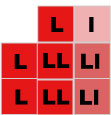
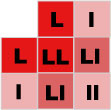
Overo paint horses often carry the recessive gene (l) which causes the GI tract to be not fully formed in the foal. This is a fatal autosomal recessive disease(gene not on the sex determining chromosome) (ll) so that one recessive gene must be inherited from each parent. The dominant gene (L) codes for normal GI tract. An animal with the genetic makeup of Ll is normal but does carry the recessive gene for the disease. (Overo paints carry the gene at a high frequency and should be tested.) One quarter of the foals produced from breeding two carriers will be born dead or be euthanized shortly after birth at a large economic loss.
| Both parents are carriers (Ll x Ll) | Carrier mated to Normal (Ll x LL) | ||
|
25% Normal foals (LL) |
 |
50% Normal foals (LL) |
A dominant trait will be expressed in the foal if the gene is inherited from either parent.
Hyperkalemic periodic paralysis (HYPP)
This is a muscular disorder resulting in uncontrollable muscle twitching, paralysis, collapse or death. The inheritance is an autosomal dominant trait. Foals inheriting one copy of the gene (NH) will have some symptoms (ranging from slight to severe) while foals inheriting two copies of the defective gene are severely affected (HH). The economic costs of producing foals with even one copy of the defective gene are very high. There is a DNA test to identify HYPP horses even if the symptoms are slight.
| Both parents are affected (NH xNH) | Normal horse mated to Affected horse (NN x NH) | ||
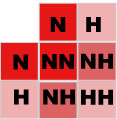 |
25% Normal (NN) 50% Affected (NH) 25% Severely affected (HH) |
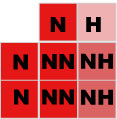 |
50% Normal (NN) 50% Affected (NH) |

