
Hormone Pathway- Leydig cells
The feedback loop that controls testosterone production begins with the hypothalamus and the secretion of GnRH. The GnRH is released into the blood stream, going to the anterior pituitary where it causes release of both LH and FSH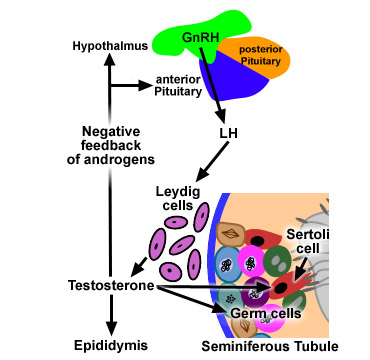 although
for this diagram we will focus on the role of LH. The LH is released into
the blood stream where it goes to the testis and specifically the Leydig
cells. The LH then causes the Leydig cells to produce testosterone. Some
of the testosterone enters the seminiferous tubules to control germ cell
(sperm) development. The other role of testosterone is to enter the blood
stream where some goes to the epididymis to control its function, while
most is distributed around the body of the stallion to control male specific
development (increased muscle mass, crest of neck, penis development). Testosterone
however also goes back to the hypothalamus and anterior pituitary where
it inhibits GnRH and LH release. Testosterone thus completes what is known
as a negative feedback loop in which it inhibits the production or release
of other hormones that in the end will control the production of testosterone.
This process will eventually stabilize testosterone production.
although
for this diagram we will focus on the role of LH. The LH is released into
the blood stream where it goes to the testis and specifically the Leydig
cells. The LH then causes the Leydig cells to produce testosterone. Some
of the testosterone enters the seminiferous tubules to control germ cell
(sperm) development. The other role of testosterone is to enter the blood
stream where some goes to the epididymis to control its function, while
most is distributed around the body of the stallion to control male specific
development (increased muscle mass, crest of neck, penis development). Testosterone
however also goes back to the hypothalamus and anterior pituitary where
it inhibits GnRH and LH release. Testosterone thus completes what is known
as a negative feedback loop in which it inhibits the production or release
of other hormones that in the end will control the production of testosterone.
This process will eventually stabilize testosterone production.

