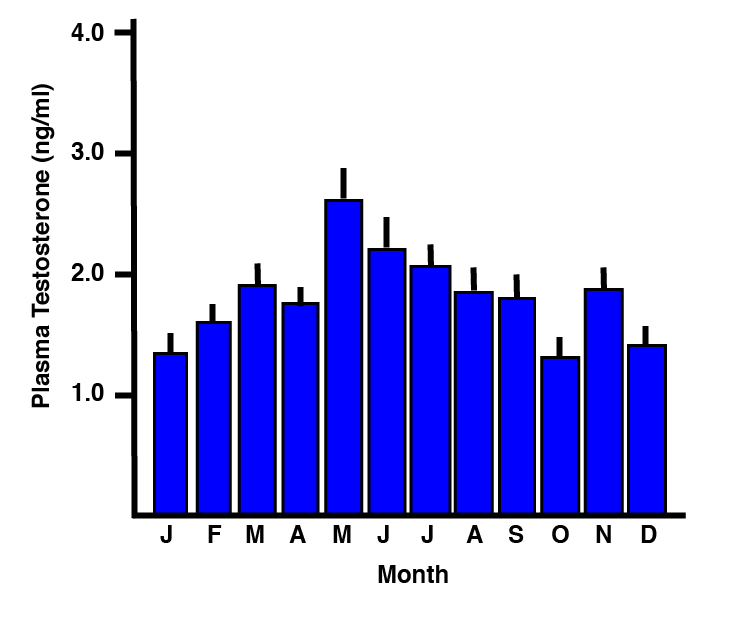
Effect of Season on Testosterone
In the female, changing light levels associated with the seasons causes a mare to have estrous cycles during the spring and summer. The male is also sensitive to seasonal effects. As in the female, the pineal gland in the stallion produces melatonin at night. Therefore as day length increases in the spring, the length of night is decreasing. The amount of melatonin from the pineal gland decreases and the hypothalamus responds with an increase in GnRH. The GnRH initiates the sequence through LH in which testosterone is produced. You can see in the diagram that stallions under natural light have lowest testosterone levels during the months of October - January. Testosterone levels increase in the spring and then decline through the summer until its lowest levels in late fall and winter. The sexual drive of the male, libido, is directly related to the level of testosterone. Libido is lowest in winter and highest in late spring.