
Hormone Pathway- Sertoli cells
In response to GnRH, not only is LH released from the anterior pituitary, but also FSH. In the diagram we will focus on the effects of FSH on the stallion. The FSH travels to the testis via the blood stream. The FSH diffuses into the seminiferous tubules where it causes Sertoli cells to produce the hormones inhibin and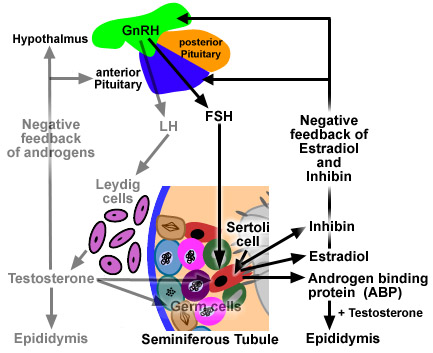 estradiol (an estrogen). In addition, FSH causes the production
of androgen binding protein (ABP). The ABP binds testosterone
that enters the seminiferous tubules and then carries it down through the
rete testis and vas efferentia to the epididymis. In the epididymis, testosterone
will control the essential functions of that organ. Although not shown,
FSH is essential for Sertoli cells to perform their role as nurse cells
to the developing germ cells. Similar to the negative feedback loop for
testosterone, estradiol and inhibin have negative feedback effects to control
release of GnRH from the hypothalamus and FSH from the anterior pituitary.
estradiol (an estrogen). In addition, FSH causes the production
of androgen binding protein (ABP). The ABP binds testosterone
that enters the seminiferous tubules and then carries it down through the
rete testis and vas efferentia to the epididymis. In the epididymis, testosterone
will control the essential functions of that organ. Although not shown,
FSH is essential for Sertoli cells to perform their role as nurse cells
to the developing germ cells. Similar to the negative feedback loop for
testosterone, estradiol and inhibin have negative feedback effects to control
release of GnRH from the hypothalamus and FSH from the anterior pituitary.

