Hormonal Changes in the Mare During Pregnancy
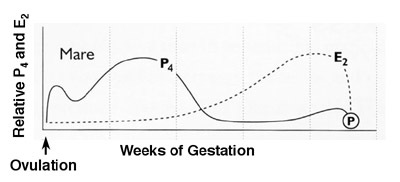
The major steriod hormones that change during pregnancy are progesterone (P4 ) and estradiol (E2). During pregnancy in the mare there is an increase in progesterone that declines during the last half of gestation. A final drop at the end of gestation is responsible for the increase in contractility of the uterus and allows parturition to occur. In the presence of progesterone, the uterus is quite, the cervix remains closed and the pregnancy is maintained. Progesterone is essential to the maitenence of pregnancy in all species. During the last half of gestation, a gradual rise in estradiol also occurs which also helps induce contractility of the uterus. Both progesterone and estradiol decrease at the time of parturition.
During gestation, mare owners often report an increase in stallion like behavior of during months 2 - 4 of gestation. This is due to the male and female fetuses producing large quantities of testosterone. This may even trigger the mare to be more aggressive to people or other mares. In approximately 25% of the mares the testosterone also induces mounting behavior.
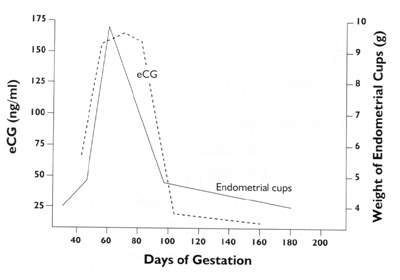
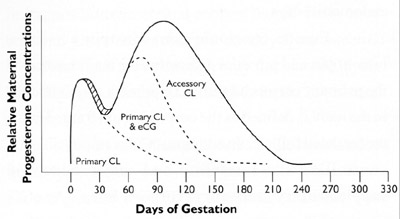
Unlike other species, the primary corpus luteum that forms from the ovulatory follicle is only maintain for 30 - 40 days. In the mare a unique feature of the placenta is that a few cells from the placenta invade the endometrium of the maternal uterus and form the endometrial cups. The endometrial cups then produce the hormone equine chorionic gonadotropin (eCG) betwee days 40 -100 of pregnancy. This hormone triggers the formation of accessory follicles which ovulate to form accessory corpora lutea. The accessory CLs then make progesterone through day 100 after which the placenta makes the progesterone needed to maintain pregnancy.