
Artificial Insemination of the Mare
Inseminate Parameters
There are many parameters which can effect the results from AI. The number and volume of sperm inseminated, number and timing of inseminations per cycle and management and fertility of the mare and stallion effect the conception rate.
Effect of Number of Sperm in Insemination on Pregnancy Rate
The table below shows that over 3 cycles, insemination with 500 million motile sperm had higher fertility per cycle (mares got pregnant sooner). Under the best management systems (mare close to ovulation at breeding), with stallions and mares of high fertility, 100 million sperm/insemination is sufficient but it is better to error on the side of excess sperm to increase fertility. The recommendation is to inseminate with 250-500 million motile sperm.
| Spermatozoa
(millions)
|
||||||
| 50 |
100 |
500 |
||||
| Cycle |
# Mares |
% Pregnant | # Mares |
% Pregnant |
# Mares |
% Pregnant |
| 1 |
36 |
22.2 |
32 |
40.6 |
134 |
54.5 |
| 2 |
28 |
17.9 |
10 |
60 |
52 |
55.8 |
| 3 |
23 |
8.7 |
4 |
50 |
21 |
33.3 |
| Total
|
36 |
41.7 |
32 |
65.6 |
134 |
81.3 |
Effect of Volume of Inseminate on Pregnancy Rate
The volume of the insemination can also effect fertility. In the graph below, volumes from 3.6 ml to 26.8 ml show a range of 40% to 75% pregnancy. Although the pregnancy rates are not significantly different, the recommendation is for an insemination volume from 10-25 ml. As the volume of the insemination increases, the loss of sperm in the insemination equipment decreases. When inseminating small volumes, slower rates of insemination will deliver more sperm in the uterus since less sperm will be lost in the insemination equipment.

Effect of Insemination Frequency and Timing
In the mare, ovulation occurs 24 to 36 hr prior to the end of estrus. The life span of the equine oocyte has been reported to be 12-24 hr and the life span of sperm in the mare tract to be about 48 hr. For maximum reproductive efficiency, the viable sperm and oocyte must be in the mare reproductive tract at the same time.
In many AI management systems, mares are bred every other day from day 3 of estrus to the end of estrus. In this system, there is no difference in breeding every day or every other day but pregnancy rates decreased when the frequency is less than every other day.
| # Mare cycles |
Frequency of Insemination |
Pregnancy rate (%) |
| 308 |
every day |
64* |
| 314 |
every other day |
63* |
| 180 |
< every other day |
53** |
*,** Values with different superscripts
are significantly different (P<0.05) |
||
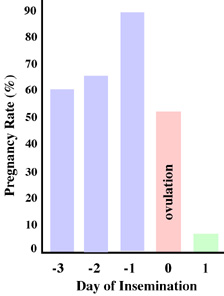
In AI management systems that use palpation or ultrasonography to manage the mare, a single insemination based on the time of ovulation can be very efficient. Insemination within one day before ovulation has the highest fertility rate although insemination 3 days before to the day of ovulation may result in pregnancy. Insemination after ovulation has decreased fertility. The recommendation in this management system is for an insemination the day before ovulation.
 |
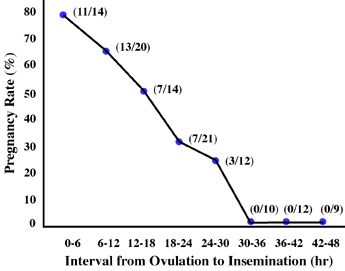 |
| From Woods et al., 1990. Equine Veterinary Journal 22(6):410-415. | |
Based on the above review of data on insemination parameters for fresh semen, it is recommended to inseminate at least 500 million motile sperm in a volume of 10 - 25 ml. In addition, insemination should occur 24 hours before ovulation.

