
Cold Shock
Cold shock can be prevented by cooling the cells slowly through the temperatures where the lipids are susceptible to clustering (19 to 8°C; 2-6 hr). Adding lipids or lipophilic molecules to the extender helps to protect the membrane (egg yolk, skim milk). Increasing the membrane fluidity at low temperatures with butylated hydroxytoluene (BHT) and preventing calcium from entering the sperm (EDTA) can also minimize cooling damage.
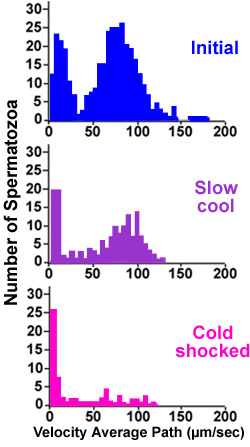
In the graphs at the right, you can see the distribution of sperm with velocity from 0 to 200 µm/sec. The initial graph shows that there are 2 populations of sperm in an ejaculate- one that are not moving or are very slow (<40 µm/sec) and another group that are moving with a higher average velocity (80 µm/sec). When the sperm are cooled slowly, the shape of the curve is similar to the initial sample although there are fewer sperm counted. Viewed with a microscope, this sample would have both nonmotile and motile sperm. When the sperm are cold shocked, the shape of the curve is much different from the other two graphs. There is a large number of sperm with no or very low velocity and almost no sperm with a higher average velocity. Viewed with a microscope, this sample would have very few moving sperm. |
 |

